Home/Blog/Tech/Amazon reports surging demand for Graviton and Trainium custom chips
Chips and Computing HardwareConfirmed
Amazon reports surging demand for Graviton and Trainium custom chips
Amazon's CEO Andy Jassy reveals robust, triple-digit growth in demand for its custom Graviton and Trainium chips, underscoring their critical role in AWS's accelerating performance and AI capabilities.
Published November 1, 20263 min readChips and Computing Hardware
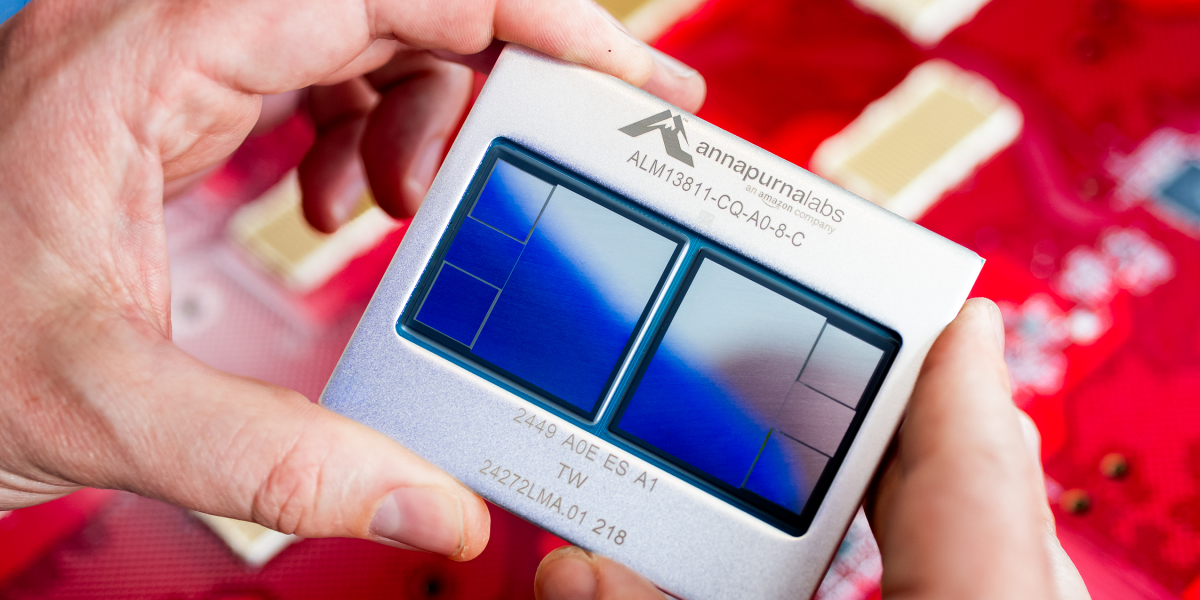
During Amazon's Q3 2026 earnings call on October 30, CEO Andy Jassy stated that demand for the company's custom-designed chips — Graviton (general-purpose CPUs) and Trainium (AI accelerators) — continues to grow at triple-digit percentages year over year. Revenue commitments for both chip families have increased more than 20× year over year, indicating substantial customer adoption and long-term contract volume.
Jassy highlighted that AI workloads are a significant driver for Graviton adoption. He explained that post-training, reinforcement learning, and agent tool use primarily run on CPUs, where Graviton delivers superior price-performance compared to alternative x86-based instances. This positions Graviton as a key component of AI infrastructure beyond just inference serving.
Amazon also announced plans to make Trainium accelerators available outside of AWS in late 2027, citing strong customer demand for on-premises or hybrid deployments. The company has open-sourced TorchNeuron, a PyTorch integration that allows developers to run existing PyTorch models on Trainium with minimal code changes, lowering the barrier to entry for teams evaluating the accelerator.
Triple-digit year-over-year demand growth for both Graviton and Trainium.
Revenue commitments up >20× year over year for each chip line.
Graviton favored for AI post-training, RL, and agent tooling due to CPU price-performance.
Trainium external availability targeted for late 2027.
TorchNeuron open-sourced to ease PyTorch migration to Trainium.
Technical analysis
The sustained triple-digit growth in custom silicon demand reflects a maturing in-house chip strategy that directly addresses the economics of large-scale cloud workloads. Graviton's Arm-based architecture has already demonstrated compelling price-performance for general-purpose compute; its extension into AI-adjacent CPU-heavy stages (post-training, reinforcement learning, agent orchestration) suggests AWS is optimizing the full pipeline rather than focusing solely on accelerator-heavy training. This aligns with the observed industry trend where CPU-bound phases — data preprocessing, model compilation, and inference serving — constitute a growing share of total AI compute cost.
Trainium's planned external availability in late 2027 signals a strategic shift from pure cloud-service differentiation to a broader silicon business model. For engineers, this raises practical questions about software portability: the open-sourcing of TorchNeuron is a concrete step toward reducing vendor lock-in, but the ecosystem maturity (kernel libraries, profiling tools, debuggers) will determine real-world adoption speed. Teams evaluating Trainium should benchmark their specific PyTorch workloads against the Neuron SDK today, as performance characteristics differ from NVIDIA GPUs in memory hierarchy, tensor core utilization, and compiler optimization paths.
The >20× revenue commitment growth implies that enterprise customers are signing multi-year capacity reservations, which in turn gives AWS predictable demand signals for fab capacity planning. This feedback loop — custom silicon → better price-performance → larger commitments → more aggressive roadmap investment — is a classic flywheel that can widen the total cost of ownership gap versus merchant silicon. However, the absence of disclosed performance-per-watt figures, die sizes, process nodes, or yield data means external analysts cannot independently verify the architectural efficiency claims. Developers should treat the price-performance advantage as a workload-dependent variable and run representative benchmarks before committing to architecture migrations.
Graviton's expansion into AI CPU stages reflects full-pipeline optimization.
Trainium external sales indicate a silicon-as-a-product strategy shift.
TorchNeuron reduces but does not eliminate porting effort; ecosystem gaps remain.
Revenue commitments enable long-term fab planning and roadmap acceleration.
Independent verification of efficiency claims is not possible without disclosed microarchitectural data.
For software engineers targeting AWS, the growth trajectory of Graviton and Trainium has immediate practical consequences. Graviton-based EC2 instances (e.g., C7g, R7g, M7g) are now default choices for many containerized and serverless workloads; CI/CD pipelines, build fleets, and microservices often see 20–40% cost reduction with recompilation or container image rebuilds for Arm64. The AI-specific note about post-training and reinforcement learning suggests that teams running RLHF, DPO, or agent frameworks (e.g., LangChain, AutoGPT) should evaluate Graviton instances for those stages, potentially reserving Trainium or GPU instances only for the heavy matrix-multiplication phases.
On the Trainium side, the Neuron SDK and TorchNeuron integration mean that PyTorch models can be compiled to Trainium's NeuronCore architecture via `torch_neuronx` or the newer `torch_xla` path. However, developers must account for differences in supported operators, dynamic shape handling, and memory management. The late-2027 external availability timeline is distant enough that most teams will engage via AWS first; those with strict data residency or latency requirements should factor this into multi-year infrastructure roadmaps.
Graviton instances offer 20–40% cost savings for Arm64-compatible workloads.
AI post-training and RL stages are CPU-bound and benefit from Graviton price-performance.
Trainium development currently requires AWS; external hardware not expected until late 2027.
Neuron SDK operator coverage and dynamic shape support are practical evaluation criteria.
 Chips and Computing HardwareConfirmed
