Home/Blog/Tech/NVIDIA, IBM, and Fermi Lab Collaborate on Quantum-Classical Codesign Platform and Error-Correction Breakthrough
Chips and computing hardware, AI and modelsConfirmed
NVIDIA, IBM, and Fermi Lab Collaborate on Quantum-Classical Codesign Platform and Error-Correction Breakthrough
NVIDIA, in partnership with IBM and Fermi National Accelerator Laboratory, is launching a quantum-classical codesign platform and has announced an error-correction breakthrough to advance practical quantum computing.
Published November 17, 20263 min readChips and computing hardware, AI and models
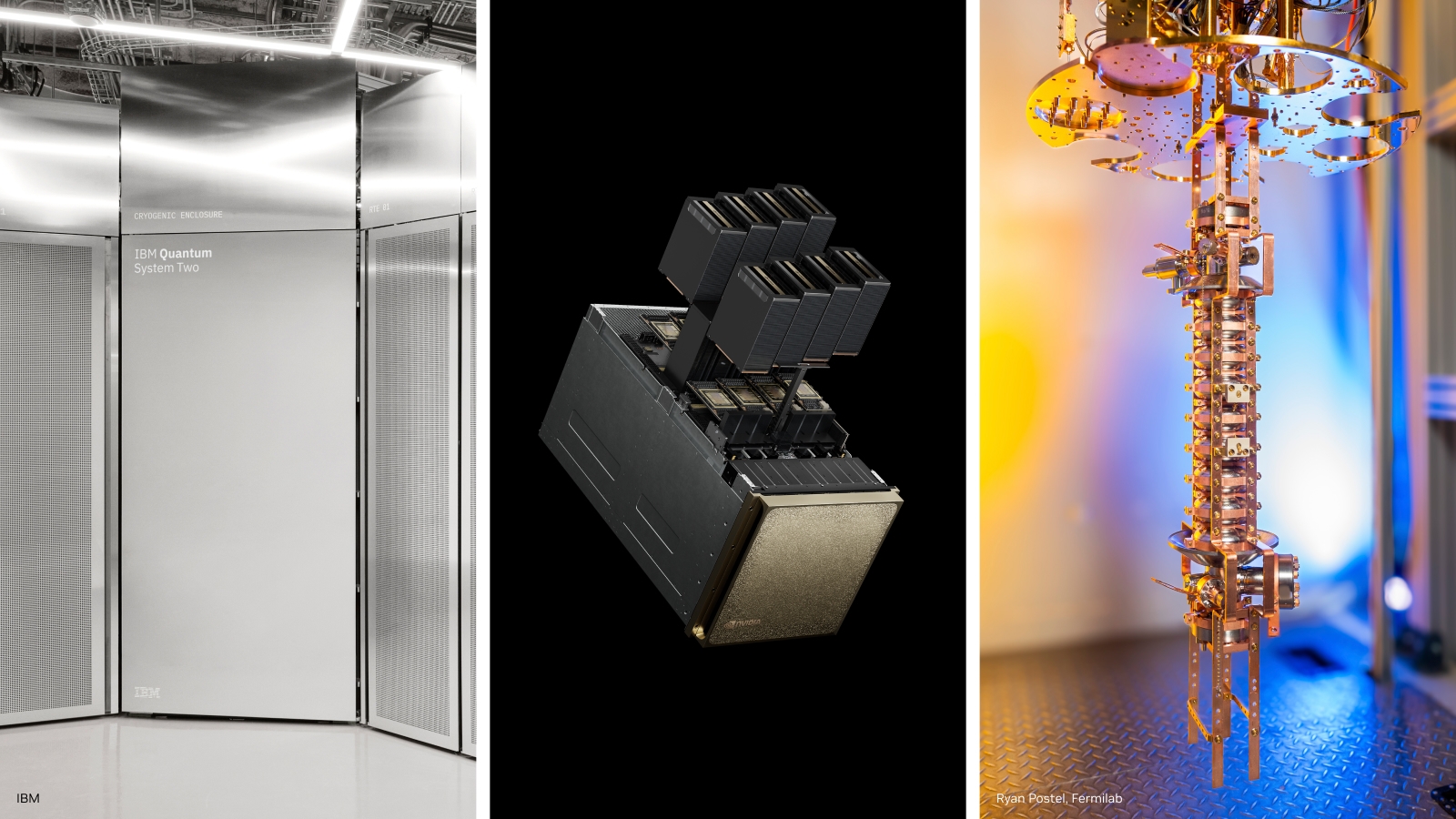
On November 16, 2026, NVIDIA announced new collaborations with IBM and the U.S. Department of Energy’s Fermi National Accelerator Laboratory (Fermilab).
These partnerships are established with the aim of launching a quantum-classical codesign platform.
The collaborations will also encompass research into next-generation modular architectures for quantum computers.
Further research areas include scientific applications for quantum computers and their integration with supercomputing systems.
A key component of this announcement is an error-correction breakthrough.
This error-correction breakthrough is specifically designed to advance practical quantum computing.
Technical analysis
The announced collaboration to launch a quantum-classical codesign platform addresses a fundamental challenge in contemporary quantum computing: the limitations of current quantum hardware. Present-day quantum processors, often characterized by their Noisy Intermediate-Scale Quantum (NISQ) nature, possess limited qubit counts, short coherence times, and susceptibility to errors. Consequently, many quantum algorithms, particularly variational ones, require significant classical computational resources to manage, optimize, and execute quantum subroutines. A codesign platform aims to provide an integrated environment where classical high-performance computing (HPC) systems can efficiently interact with quantum processors.
From an engineering perspective, such a platform implies a focus on interoperability and efficient resource orchestration. Developers working on quantum applications would require robust interfaces and frameworks to partition problems, execute quantum circuits, and process results using classical supercomputers. The practical engineering consequences include the need for optimized data transfer mechanisms between classical and quantum components, low-latency communication protocols, and sophisticated workload management systems. The stated goal of researching 'supercomputing integration' directly points to the necessity of scalable classical support to handle the increasing complexity and data demands of hybrid quantum-classical algorithms.
The announcement of an error-correction breakthrough is particularly significant for the long-term viability of quantum computing. Quantum bits (qubits) are inherently fragile and prone to errors caused by environmental noise and decoherence. These errors accumulate rapidly, severely limiting the depth and reliability of quantum computations. For quantum computers to achieve fault tolerance and reliably execute complex algorithms beyond the capabilities of classical machines, robust quantum error correction (QEC) is indispensable. QEC involves encoding quantum information redundantly across multiple physical qubits to protect it from noise, a process that typically demands substantial overhead in terms of physical qubits and complex control operations.
While specific technical details of this breakthrough were not disclosed, any advancement in error correction directly impacts the feasibility of building scalable and reliable quantum computers. For software engineers, an effective error-correction mechanism would eventually enable the design and execution of quantum algorithms with greater confidence in their output, moving beyond the current reliance on error mitigation techniques for NISQ devices. This would influence the development of quantum programming languages, compilers, and toolchains, which would need to incorporate error-correction protocols and manage the mapping of logical, error-corrected qubits to physical hardware. The absence of specific details means developers cannot yet evaluate its direct impact on current projects or specific hardware implementations.
The collaborations between NVIDIA, IBM, and Fermilab underscore the interdisciplinary nature of advancing quantum computing. NVIDIA's expertise in accelerated computing, IBM's established presence in quantum hardware and software, and Fermilab's experience in scientific computing and fundamental research suggest a comprehensive approach to tackling the challenges of quantum-classical integration and error correction. However, the announcement provides a high-level overview of these initiatives. Specific technical details regarding the architecture of the quantum-classical codesign platform, the precise nature or implementation of the error-correction breakthrough, or the timelines for these developments were not disclosed. The announcement does not specify the types of quantum hardware involved, the programming models or APIs that will be exposed to developers, or the performance metrics of the error correction. Consequently, developers cannot yet assess the direct practical implications for their current projects or future development roadmaps.
 Chips and computing hardware, AI and modelsConfirmed