Home/Blog/Tech/Meta's Muse Spark Open Model for Agentic Coding Now on AWS SageMaker JumpStart AI and models, software engineering, cloud platformsConfirmedMeta's Muse Spark Open Model for Agentic Coding Now on AWS SageMaker JumpStart
Meta's Muse Spark Open, a powerful AI model for agentic coding, is now available on Amazon SageMaker JumpStart, offering advanced capabilities for enterprise software engineering.
Published October 15, 202611 min readAI and models, software engineering, cloud platforms
Confirmed facts
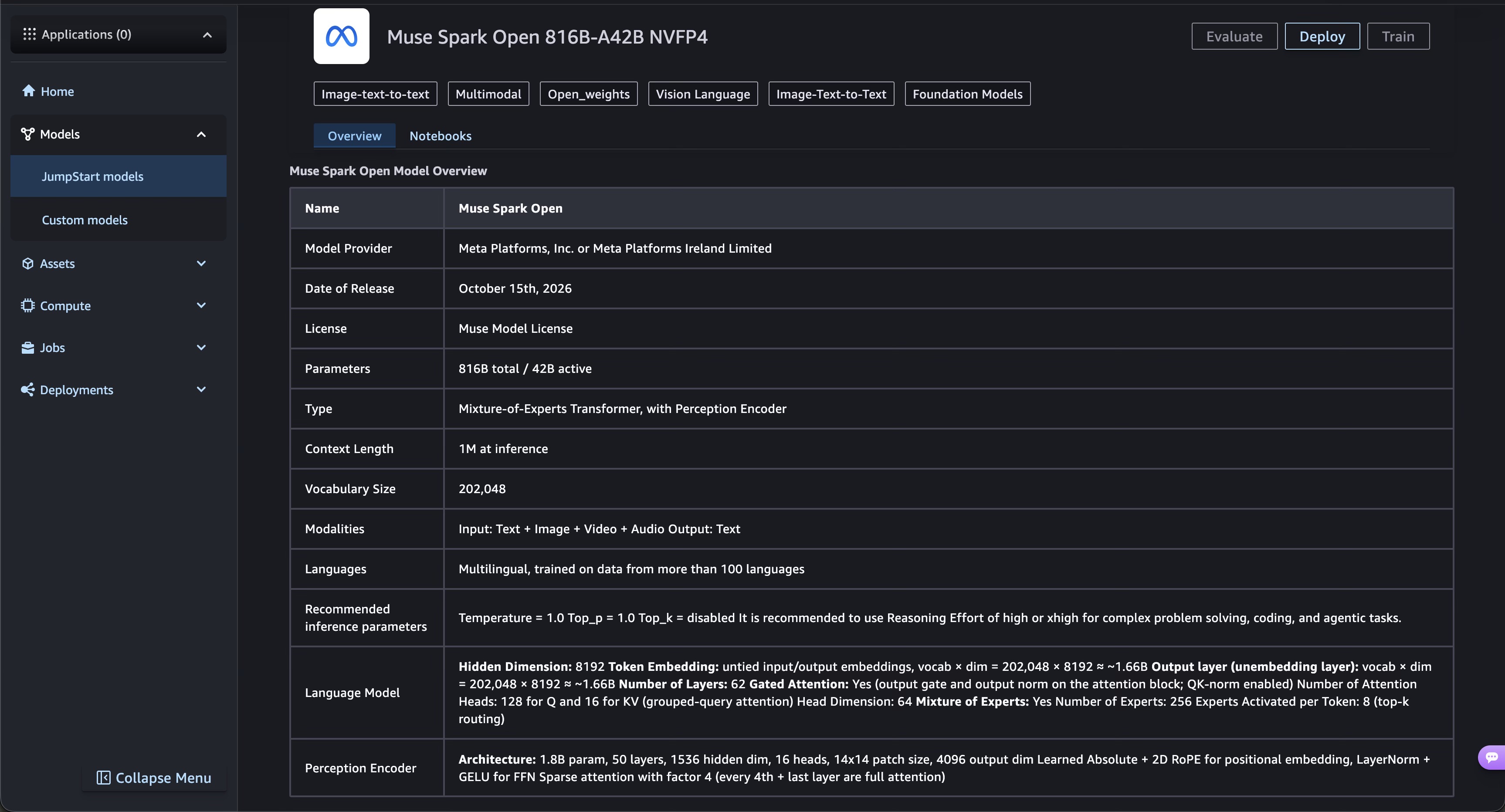
Meta's Muse Spark Open model is now available on Amazon SageMaker JumpStart. This model is an open-weight offering from Meta, specifically optimized for agentic coding workflows. It is designed to support multi-step reasoning and tool calling within enterprise software engineering contexts on AWS infrastructure. The architecture of Muse Spark Open is confirmed to be a Mixture-of-Experts (MoE) model, featuring 816 billion total parameters with 42 billion parameters active per token. A significant characteristic of this model is its 1-million-token context window, which enables it to process extensive amounts of information, including entire projects, dependencies, legacy code, and thousands of files, without requiring tasks to be broken down into smaller segments. The model is capable of accepting diverse input modalities, including text, images, documents, audio, and audio-video, while generating text output. Its training focused on real-world developer workflows, such as multi-file refactoring and extended debugging sessions, allowing it to plan, execute actions, observe outcomes, and self-correct over prolonged operational horizons, rather than performing only single tool calls.
For deployment on SageMaker JumpStart, two distinct variants of Muse Spark Open are provided: a BF16 variant, identified as Muse-Spark-Open-816B-A42B, and an NVFP4 quantized variant, named Muse-Spark-Open-816B-A42B-NVFP4. The NVFP4 quantized variant offers a notable advantage by requiring approximately one-quarter of the memory compared to the BF16 version, facilitating more cost-efficient deployment. Customers can deploy Muse Spark Open through SageMaker JumpStart with a streamlined process, typically involving a few clicks. Upon deployment, the model's endpoint operates within the customer's own AWS account, granting them full control over their source code and prompts. Access to deploy and utilize the model is available via the SageMaker JumpStart model catalog within the SageMaker console or programmatically using the SageMaker Python SDK.
Technical analysis
The introduction of Meta's Muse Spark Open on Amazon SageMaker JumpStart represents a notable development for software engineering practices leveraging artificial intelligence. This model's confirmed characteristics—an open-weight status, a Mixture-of-Experts (MoE) architecture, an exceptionally large context window, multimodal input capabilities, and optimization for agentic coding workflows—collectively point towards a shift in how developers can interact with and integrate AI into complex software development tasks. The availability on SageMaker JumpStart further defines the operational context, emphasizing ease of deployment and customer control within a cloud environment. Analyzing these confirmed features allows for an understanding of the practical engineering consequences, potential workflow transformations, and the specific advantages offered by this particular model design and deployment strategy, all tied directly to the provided evidence.
The combination of a massive parameter count with an efficient MoE architecture, coupled with a context window capable of ingesting entire projects, addresses several long-standing challenges in applying AI to large-scale software development. Furthermore, the provision of a quantized variant directly impacts the economic and practical feasibility of deploying such a powerful model. Understanding these technical underpinnings is crucial for software engineers considering the adoption of advanced AI models for tasks ranging from code generation and refactoring to complex debugging and architectural analysis. This analysis will focus on the direct, derivable consequences for developers and engineering teams, grounded strictly in the confirmed details provided by the source, without introducing any unsupported speculation.
The Mixture-of-Experts (MoE) Architecture in Practice
The confirmed use of a Mixture-of-Experts (MoE) architecture for Muse Spark Open, with 816 billion total parameters and 42 billion active per token, carries significant implications for its operational characteristics and practical utility in software engineering. An MoE design fundamentally allows a model to possess a vast knowledge capacity, represented by the total parameter count, while maintaining a more manageable computational footprint for individual inference requests. The confirmed detail that only 42 billion parameters are active per token means that, for any given input token, only a subset of the model's total 'experts' are engaged. This design choice directly addresses the challenge of scaling large language models: achieving high capacity without incurring the prohibitive computational cost of activating all parameters for every single operation.
From an engineering perspective, this architecture suggests that Muse Spark Open can potentially leverage a broad and deep understanding of programming concepts, diverse codebases, and various software engineering paradigms, as implied by its 816 billion total parameters. Simultaneously, the per-token compute cost, being closer to that of a 42-billion-parameter dense model, indicates a more efficient use of computational resources during inference. This efficiency is critical for real-world applications, particularly in scenarios involving long sequences or high throughput requirements, which are common in agentic coding workflows. The MoE structure, therefore, enables the model to be both comprehensive in its knowledge base and relatively efficient in its execution, a balance that is highly beneficial for complex, multi-step software development tasks. What was not disclosed are the specific routing mechanisms or the number of experts utilized within this MoE architecture, nor any specific performance benchmarks related to its MoE operation.
Leveraging the 1 Million Token Context Window
The confirmed 1-million-token context window of Muse Spark Open represents a substantial advancement for AI-driven software development. This capacity directly enables the model to 'ingest an entire project—including dependencies, legacy code, and thousands of files—without splitting tasks into smaller pieces,' as stated in the announcement. For software engineers, this capability fundamentally alters the approach to providing context for AI assistants. Traditionally, developers have had to meticulously select and provide relevant code snippets, documentation, or architectural diagrams to an AI model, often constrained by much smaller context limits. The 1M-token window largely alleviates this burden, allowing for a more holistic understanding of a codebase.
The practical engineering consequences are profound. When performing complex operations like multi-file refactors or debugging sessions, the model can maintain a comprehensive view of the entire project state. This reduces the likelihood of introducing inconsistencies or overlooking dependencies that might reside in files not explicitly provided in a smaller context. For example, during a refactor that spans multiple modules, the model can simultaneously consider the implications across all affected files, ensuring API compatibility and consistent logic. Similarly, in debugging, the ability to ingest an entire project allows the model to trace issues across disparate parts of the system, potentially identifying root causes that would be missed by a more localized analysis. This broad contextual awareness supports more coherent and reliable AI-generated or AI-assisted code modifications, directly addressing the confirmed training focus on 'multi-file refactors and long debugging sessions.' What was not disclosed are specific performance characteristics or latency implications when operating at the full 1-million-token context capacity, nor any specific limitations on the types of files or project structures it can ingest.
Agentic Coding Workflows and Multimodal Input Capabilities
Muse Spark Open's optimization for 'agentic coding workflows' and its confirmed ability to 'plan, act, observe results, and self-correct over long horizons' signify a move beyond simple code generation towards more autonomous and iterative development assistance. This agentic paradigm implies that the model is not merely a reactive tool but can engage in multi-step reasoning, making decisions, executing actions (presumably through tool calling, as confirmed), evaluating the outcomes, and adjusting its strategy. This capability is particularly valuable for complex tasks like 'multi-file refactors and long debugging sessions,' where a single, instantaneous response is often insufficient. The model's ability to 'self-correct' suggests an internal feedback loop, enhancing its reliability over extended interactions.
Further enhancing these agentic capabilities is the model's confirmed multimodal input support, accepting text, images, documents, audio, and audio-video. This broad input spectrum allows developers to interact with the AI agent using a richer set of information sources. For instance, an engineer could provide a text description of a bug, an image of a UI component, a document outlining system architecture, or even an audio-video recording demonstrating a problematic workflow. The model's capacity to process these diverse inputs and generate text output means it can synthesize information from various forms of project documentation and communication, leading to a more comprehensive understanding of the task at hand. This multimodal capability, combined with agentic reasoning, provides a more natural and powerful interface for complex software engineering problems, reducing the need for developers to manually translate diverse information into a purely textual format for the AI. What was not disclosed are the specific tools the model can call or the internal mechanisms of its planning and self-correction processes, nor any specific limitations on the types or formats of multimodal inputs it can effectively process.
Deployment Efficiency: BF16 and NVFP4 Quantization
The availability of Muse Spark Open in two distinct variants—BF16 and NVFP4 quantized—directly addresses critical deployment considerations for enterprise users. BF16 (BFloat16) is a common floating-point format for deep learning, offering a balance between numerical precision and memory footprint. The NVFP4 variant, however, introduces 4-bit quantization, which is confirmed to require 'roughly a quarter of the memory' compared to the BF16 version. This significant reduction in memory footprint has direct and substantial engineering consequences, primarily impacting the cost-efficiency and accessibility of deploying such a large model.
For organizations, memory consumption is a primary driver of inference costs, particularly for large language models. By reducing memory requirements by approximately 75%, the NVFP4 variant enables the deployment of Muse Spark Open on hardware with less VRAM, or allows for a higher number of concurrent inference requests on existing hardware. This translates to lower operational expenses and potentially higher throughput, making advanced AI coding capabilities more economically viable for a broader range of AWS customers. The choice between BF16 and NVFP4 allows engineering teams to balance precision and performance against cost and resource availability. While the source confirms the memory reduction, it does not disclose any specific performance or output quality differences between the BF16 and NVFP4 variants, which would typically be a consideration when choosing between different quantization levels. However, the confirmed 'cost-efficient deployment' benefit for NVFP4 highlights its primary advantage, directly inferring its impact on operational costs.
SageMaker JumpStart Integration and Control
The deployment of Muse Spark Open through Amazon SageMaker JumpStart provides a structured and controlled environment for enterprises to integrate this powerful AI model. The confirmed 'few clicks' deployment process simplifies what could otherwise be a complex setup involving infrastructure provisioning, model loading, and endpoint configuration. This ease of access lowers the barrier to entry for development teams looking to experiment with or productionize advanced AI coding agents. More critically, the confirmation that 'the endpoint running in their own AWS account for full control over source code and prompts' addresses paramount concerns regarding data privacy, security, and intellectual property.
By ensuring that the model's inference endpoint operates within the customer's AWS account, all input prompts and generated outputs remain within the customer's defined security boundaries. This is a significant advantage for enterprise software engineering, where proprietary code and sensitive project details are routinely handled. The 'full control over source code and prompts' implies that customers retain ownership and governance over the data flowing through the model, which is essential for compliance and internal security policies. This deployment model contrasts with solutions where prompts and data might be processed by a third-party service outside the customer's direct control. While the source does not disclose specific fine-tuning capabilities for Muse Spark Open, the general SageMaker JumpStart framework, combined with full control over the endpoint, provides a robust foundation for secure and compliant AI integration into enterprise workflows. The ability to use the SageMaker Python SDK also enables programmatic deployment and management, facilitating integration into existing CI/CD pipelines or automated workflows.
Practical Engineering Considerations for Adoption
For software engineering teams considering the adoption of Muse Spark Open, several practical considerations emerge directly from its confirmed capabilities. The model's optimization for agentic coding and its 1-million-token context window suggest a shift from using AI for isolated tasks to integrating it as a more continuous, context-aware assistant. Developers can explore leveraging its ability to ingest entire projects for tasks requiring broad architectural understanding, such as identifying cross-cutting concerns during refactoring or analyzing the impact of a change across a large codebase. The multimodal input capabilities mean that engineering teams can experiment with feeding the model diverse forms of project information, potentially streamlining the process of onboarding the AI to a new project or task.
When evaluating Muse Spark Open, developers could perform specific tests. For instance, they might assess its performance on a complex, multi-file refactor within their own proprietary codebase, comparing the AI-assisted outcome against manual efforts in terms of accuracy, consistency, and time saved. Another evaluation could involve presenting the model with a challenging bug that spans multiple files and requires iterative debugging, observing its 'plan, act, observe, self-correct' loop in action. Testing its multimodal input by providing a combination of code, architectural diagrams (images), and design documents could reveal its efficacy in synthesizing disparate information. The choice between the BF16 and NVFP4 variants will involve a trade-off analysis between potential resource savings and any perceived differences in output quality or inference latency, though the source only confirms the memory reduction for NVFP4. What was not disclosed are specific performance benchmarks for either variant, or detailed guidance on how to best structure prompts for optimal agentic behavior across different modalities.